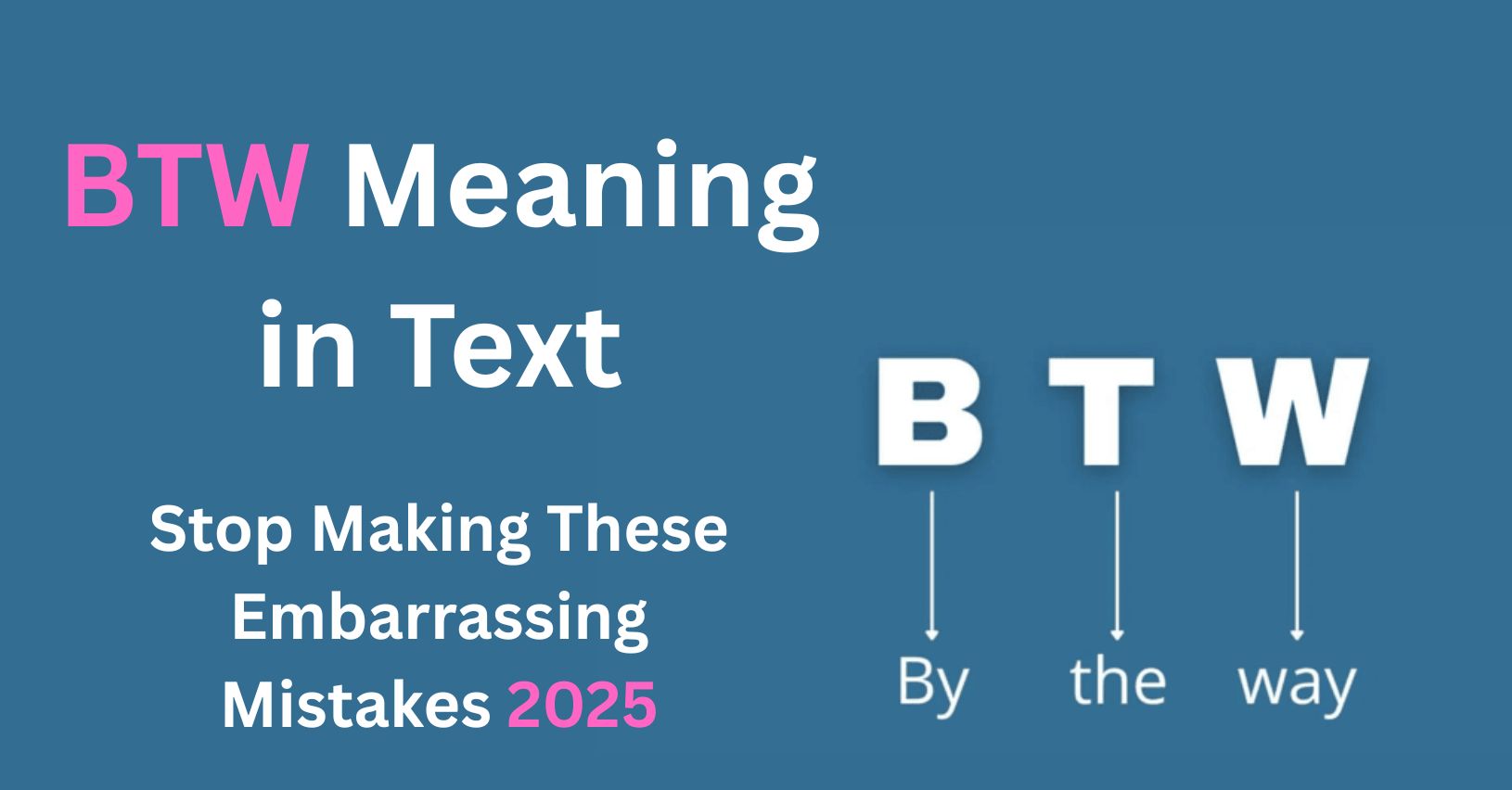
BTW Meaning Ever received a text that starts with BTW and wondered about its deeper implications? You’re not alone. This three-letter acronym dominates digital communication across platforms-from WhatsApp chat to professional emails.
Understanding what BTW means in text isn’t just about knowing it stands for “by the way.” It’s about mastering conversation flow, reading communication tone, and choosing perfect transitional phrases for every situation.
What Does “BTW” Mean in Text?
BTW Meaning BTW stands for “By The Way.” It’s a topic transition phrase that introduces secondary information without disrupting ongoing conversations. Americans use it constantly in online conversations, text messaging, and even in spoken English usage.
Think of BTW as conversational glue. It connects ideas smoothly while maintaining natural rhythm. When you type “BTW, did you finish that report?” you’re shifting focus gently. This text abbreviation emerged from early internet chat rooms, where typing speed mattered.
Example in Text:
- Friend texting: “I’m grabbing coffee. BTW, want your usual order?”
- WhatsApp group chat: “Meeting’s confirmed for Tuesday. BTW, parking’s free after six.”
- Work Slack message: “Great presentation today! BTW, could you share those slides?”
- Social media comment: “Love this recipe! BTW, does it work with almond milk?”
Understanding BTW Across Different Platforms
BTW Meaning BTW, meaning in WhatsApp chat typically signals casual, friendly communication. People use it to add forgotten details or shift topics smoothly. On WhatsApp, lowercase “btw” dominates because autocorrect handles it naturally.
What does btw mean for a woman in texting? There’s no gender-specific meaning-BTW functions identically regardless of who’s typing. However, some women report that men occasionally misread BTW as passive-aggressive when discussing relationship topics.
When Should You Use “BTW”?
BTW shines in specific scenarios where informal language fits naturally. Understanding these contexts prevents awkward communication mistakes. Use it when adding supplementary information, introducing forgotten details, or shifting topics casually among peers. The key is matching BTW to your relationship with the recipient and the conversation’s formality level.
Digital communication demands flexibility. What works perfectly with college friends might bomb with your company’s CEO. Americans increasingly blend professional communication with casual communication, especially in a hybrid work culture.
Suitable Contexts
- Text messaging with friends, family, or close colleagues
- Informal language in workplace communication tools like Slack or Teams
- Social media comments, captions, and direct messages
- Quick updates in group chats or community forums
- Adding additional information cues to ongoing casual conversations
- Topic-shifting among peers who share similar communication styles
When to Avoid
- Formal emails to clients, executives, or job applications
- Professional writing, like reports, proposals, or presentations
- Academic papers, research documents, or scholarly communication
- Legal correspondence or official documentation
- Initial contact with potential employers or networking connections
- Customer service communication requires a polished, respectful tone
Creative & Conversational Alternatives
- “While I’m thinking about it…” adds authentic spontaneity to messages. It sounds exactly like natural speech patterns Americans use daily. Example: “While I’m thinking about it, did you book those concert tickets?” This creates warm, genuine conversation flow in personal communications.
- “Speaking of which…” demonstrates clever topic-shifting in emails or conversations. It shows you’re actively listening and connecting ideas. Example: “Speaking of which, how did your interview go?” This transition feels intelligent and engaged rather than random or scattered.
- “Not to change the subject, but…” shows self-awareness about shifting focus. It’s respectful while allowing necessary topic changes. Example: “Not to change the subject, but we should discuss vacation scheduling soon.” This works perfectly when you need smooth topic change expressions during important conversations.
More post: Master TTY Meaning in Text Ultimate Guide to Flawless Communication 2025
How “BTW” Can Be Misunderstood
BTW Meaning Communication tone dramatically affects how people interpret BTW. What seems innocent to you might sound dismissive to others. Consider this: “BTW, you forgot the deadline again.” That sentence could trigger defensiveness even if you meant it helpfully. The passive-aggressive tone emerges from combining BTW with criticism or corrections unexpectedly.
Misunderstood texting acronyms cause countless communication breakdowns. BTW particularly struggles when discussing sensitive topics. Americans often read subtext into text abbreviations, especially in workplace communication. If your boss writes “BTW, we need better performance,” you’ll probably stress all day.
What Does BTW Mean in Different Contexts
Btw, meaning Urban Dictionary includes various interpretations beyond “by the way.” Some users claim it sometimes means “back to work” or “between,” though these aren’t standard. The Urban Dictionary reflects how slang evolves organically through usage.
Btw, meaning between occasionally appears in very specific contexts, though it’s rare. Most English speakers wouldn’t recognize this usage. When someone writes “the agreement BTW both parties,” they’re likely making an error or trying creative shorthand.
BTW in International and Cultural Contexts
Btw, meaning in chat Tagalog follows English conventions since BTW originated from English-speaking internet culture. Filipino users typically understand it as “by the way,” even when chatting in Tagalog. Code-switching between languages happens naturally in online conversations.
Who are you btw meaning represents a complete question: “Who are you, by the way?” This phrasing appears when someone’s asking for identification or clarification mid-conversation. Online forums and social media users frequently employ this construction when joining ongoing discussions.
Polite, Professional, and Casual Alternatives to “BTW”
BTW Meaning Mastering polite alternatives expands your communication clarity significantly. Different situations demand different transitional phrases. Professional alternatives maintain formality while keeping conversations flowing smoothly.
Conversational transitions separate good communicators from great ones. Native English speakers instinctively vary their topic transition phrases based on context. Non-native speakers benefit enormously from studying these alternatives. Whether you’re handling email etiquette, navigating workplace messaging guidelines,
Polite Alternatives
- “Just to let you know…” introduces information gently without seeming pushy. Use it when providing helpful updates to colleagues or acquaintances. Example: “Just to let you know, tomorrow’s meeting starts at nine instead of ten.” This phrase softens potentially disruptive news perfectly.
- “For your information…” works brilliantly in professional communication requiring formality. It signals you’re providing valuable context without demanding action. Example: “For your information, the quarterly report shows 15% growth.” This alternative excels in email-friendly transitional phrases for business correspondence.
- “I wanted to mention…” shows thoughtfulness and intention. It indicates you’ve been thinking about this information specifically for them. Example: “I wanted to mention that your presentation really impressed the board.” This creates warmth while maintaining professionalism throughout workplace communication exchanges.
Professional Alternatives
- “As a side note…” transitions smoothly without minimizing importance. It’s perfect for meeting updates or team discussions where you’re adding relevant context. Example: “As a side note, our competitor launched a similar feature last week.” This maintains a professional tone while introducing new information naturally.
- “Additionally…” serves report writing and presentation speech transitions excellently. It builds logically on previous points without casual informality. Example: “Additionally, we’ve secured three new clients this quarter.” This word elevates your business communication instantly, showing sophisticated thinking patterns clearly.
- “On a related note…” connects ideas while signaling a slight shift. Use it when transitioning between connected topics during meetings or emails. Example: “On a related note, have we considered budget implications for this project?” It maintains focus while broadening discussion scope appropriately.
Casual Alternatives
- “Oh, and…” mimics natural speech perfectly for text-based conversations with friends. It’s spontaneous and warm without any pretense. Example: “Dinner was amazing! Oh, and thanks for grabbing dessert.” This works beautifully in informal tone situations where authenticity matters most.
- “In case you didn’t know…” adds playful energy to social media posts and friend group chats. It shares information while assuming they might already know. Example: “In case you didn’t know, that band’s touring next month!” This creates friendly, helpful vibes throughout casual communication exchanges.
- “Just so you know…” balances information-sharing with casualness perfectly. It’s Americans’ go-to phrase for friendly updates. Example: “Just so you know, I’ll be ten minutes late.” This alternative fits virtually any casual scenario while maintaining communication clarity effortlessly.
Choosing the Right Alternative Based on Context
| Scenario | Best Alternative | Why It Works |
| Emailing your boss | “Additionally…” or “I wanted to mention…” | Maintains professional respect while adding information |
| Texting close friends | “Oh, and…” or “btw.” | Keeps conversation casual and authentic |
| Client presentation | “On a related note…” | Shows a thoughtful connection between ideas |
| WhatsApp family group | “Just so you know…” | Friendly, informative without being formal |
| Dating app conversation | “Speaking of which…” | Demonstrates engagement and listening skills |
| Team discussions on Slack | “As a side note…” | Professional yet approachable for colleagues |
Selecting appropriate transitional phrases requires reading your audience accurately. Consider relationship dynamics, platform formality, and message importance. What does BTW mean in dating scenarios? Usually, casualness and comfort-but early conversations might benefit from spelling out “by the way” for clarity. Match your language to theirs initially.
Communication tone assessment involves multiple factors simultaneously. Age differences, industry norms, company culture, and individual personalities all influence ideal phrasing choices. Someone comfortable with internet slang appreciates BTW readily. Others prefer traditional language regardless of platform.
The Evolution of “BTW” in Digital Language
BTW originated in early internet chat rooms during the 1990s, when dial-up connections made every character count. AOL Instant Messenger users popularized countless text abbreviations to speed conversations. BTW emerged as essential vocabulary alongside BRB, LOL, and TTYL. These acronyms in texting fundamentally changed how Americans communicated online forever.
Flip phone texting cemented BTW’s importance during the 2000s. Remember typing on number pads? Each letter required multiple button presses. Text messaging costs money per message, encouraging brevity. BTW saved precious characters and thumb energy.
BTW, in Modern Communication Platforms
Smartphones transformed digital communication completely after 2007. Full keyboards made typing easier, yet BTW survived because it served psychological purposes beyond efficiency. It signals casualness, creates conversational rhythm, and softens topic transitions. Social media language adopted BTW enthusiastically adopted across Facebook, Twitter, Instagram, and TikTok because it maintained an authentic voice.
Hybrid work culture accelerated during 2020-2025, blending professional communication with informal language unprecedentedly. Slack, Teams, and Zoom chats have normalized text abbreviations in workplace communication. Suddenly, executives typed “BTW” in company channels.
Reading BTW’s Hidden Meanings
BTW carries subtle implications beyond its dictionary definition. When your manager writes “BTW, can we talk?” your stress levels spike immediately. That’s because BTW can minimize serious topics, creating anxiety through casual framing. Linguistic tone analysis requires reading the surrounding context, sender personality, and relationship history simultaneously for accurate interpretation.
What does btw mean for a woman discussing relationship concerns? Often, she’s testing the waters before diving into difficult conversations. “BTW, I’ve been thinking about u,s” signals an incoming serious discussion despite a casual opener. Men sometimes miss these cues, responding too casually to genuine concerns.
Common BTW Mistakes to Avoid
Overusing BTW makes you sound scattered or unprofessional. Multiple BTWs in one message suggest poor organization: “BTW, I’m running late. BTW, did you get my email? BTW, see you soon.” Instead, structure thoughts clearly before typing. Use BTW sparingly-once per conversation typically suffices for maintaining natural conversation flow without annoying recipients.
Passive-aggressive texting often weaponizes BTW unintentionally. “BTW, you never responded to my last three messages” sounds accusatory despite friendly framing. This contradiction confuses recipients and damages relationships. If you’re addressing problems, skip BTW entirely.
Professional Context Guidelines
Workplace messaging guidelines vary dramatically between industries and companies. Tech startups embrace informal language freely, while law firms maintain stricter formal language standards. Observe senior colleagues’ texting etiquette before matching their style. If executives use BTW in company Slack channels, you’re probably safe following suit appropriately.
Email etiquette for external communication demands extra caution. First impressions matter enormously with potential clients or partners. Avoid using text abbreviations until you use them first. Professional writing alternatives like “Additionally” or “On a related note” demonstrate polish without seeming stuffy.
BTW Across Generations and Demographics
Generation Z users treat BTW as natural as breathing. They’ve never known communication without text abbreviations. Millennials adapted comfortably, having witnessed the transition from formal email to casual texting. Generation X and Boomers sometimes struggle with internet slang, preferring traditional phrasing.
Regional variations exist even within America. New York professionals tend toward faster, abbreviated communication. Southern states often maintain more formal, polite language even in texts. West Coast tech culture embraces casual digital communication enthusiastically.
Mastering BTW for Different Relationships
Customer service communication rarely benefits from BTW usage. Customers expect professionalism and clarity-text abbreviations might seem dismissive or unprofessional. Instead, use email-friendly transitional phrases like “I’d also like to mention…” or “For your reference…” These maintain a helpful tone while respecting formal email standards expected in business relationships.
Dating app communication allows more informal language freedom, though early messages benefit from caution. What does BTW mean in dating initially? It can signal comfort and casualness-positive signs of connection. However, overusing it might seem immature or careless.
More post: Master TTY Meaning in Text Ultimate Guide to Flawless Communication 2025
Mastering “BTW” Means
You’ve explored the BTW meaning in text comprehensively, from basic definition to advanced usage across contexts. By the way, meaning extends beyond simple translation to encompass communication tone, relationship dynamics, and platform-specific norms. Understanding when BTW works perfectly versus when alternatives serve you better separates effective communicators from amateur ones.
Digital communication continues evolving rapidly. Text messaging, social media language, and workplace communication blend increasingly, demanding flexibility and awareness. Your ability to deploy BTW appropriately and choose better transitional phrases directly impacts relationship quality, professional success, and daily interaction effectiveness across all platforms and relationships simultaneously.
Frequently Asked Questions
How do you use BTW in a sentence?
BTW introduces additional information or topic shifts casually. Example: “I’ll meet you at six. BTW, should I bring anything?” It works best in informal conversations and texts with friends.
What does pro stand for in text?
Pro means professional or expert-level. It describes someone skilled at something. Example: “She’s a pro at coding.” Sometimes it means “in favor of,” like “pro-environmental.”
How to use btw in chat?
Type BTW before adding extra information or changing topics. Keep it casual with friends and colleagues. Example: “Great job today! btw, are we meeting tomorrow?”
What is the use of BTW?
BTW transitions conversations smoothly by introducing secondary thoughts without disrupting the flow. It adds context, shifts topics, or shares forgotten details casually.
Conclusion
Mastering BTW meaning in text transforms your digital communication skills dramatically. You’ve learned its definition, appropriate contexts, professional alternatives, and usage strategies across different American settings. Whether texting friends, emailing colleagues, or posting on social media, you now possess the knowledge to choose perfect transitional phrases. Remember that effective communication isn’t just about what you say-it’s about how you say it. Apply these insights confidently, and watch your conversations flow more naturally than ever before.

Passionate about innovation and growth. Dedicated to managing, optimizing, and creating seamless experiences while supporting diverse content and users with professionalism and clarity every day.