Nth Meaning Ever received a text saying “for the nth time” and wondered what your friend actually meant? You’re not alone. This seemingly simple phrase confuses thousands of people daily across digital platforms.
The term “nth” originates from mathematics, where ‘n’ represents any variable number in a sequence. However, when someone texts it today, they’re rarely discussing algebra. Instead, they’re expressing frustration, repetition, or sheer exasperation about something happening repeatedly.
What Does “Nth” Mean in Text?
“Nth” in text means an unspecified number of repetitions, typically expressing that something has happened countless times. People use it when they’ve lost track of how many times they’ve repeated themselves or experienced something.
The phrase transforms mathematical notation into conversational shorthand. When your roommate texts “I’ve asked for the nth time to clean up,” they’re emphasizing repetition without counting exact instances.
In Textual Use Real Examples
Nth Meaning People deploy “nth” across various digital conversations with different emotional undertones. On Snapchat, someone might caption “Wearing black for the nth day” to show their predictable fashion choices humorously.
In WhatsApp group chats, you’ll see “We’ve discussed vacation plans for the nth time,” expressing playful exasperation. Instagram captions often feature it like “Posting coffee pics for the nth morning” with self-aware humor.
More post : Unlock IMAO Meaning Complete Usage & Alternatives Guide 2025
“Nth” Stands For and Means in Textual Communication
| Context | Implication | Emotional Tone |
| Emotional | Expresses irritation or frustration | Negative, exasperated |
| Descriptive | Indicates a high position in the sequence | Neutral, observational |
| Hyperbolic | Creates dramatic emphasis | Playful, exaggerated |
“Nth” isn’t an abbreviation-it’s a figurative expression borrowed from mathematical notation. Many people mistakenly treat it like texting terminology, such as “BRB” or “LOL,” but it functions differently as a colloquial shortcut for expressing countless times.
The expression serves multiple purposes in online comments and casual interactions. It adds dramatic emphasis without specifying exact numbers, creating conversational flexibility. Whether you’re expressing genuine annoyance or playful sarcasm, this phrase adapts to your intended tone while maintaining ambiguity about actual frequency.
Origin of “Nth” From Algebra to Texting
Nth Meaning The mathematical origin traces back to algebraic notation, where ‘n’ represents any variable number in sequences. Mathematicians use “nth term” to describe a general term in a sequence without specifying which position exactly.
During the 20th century, academics and engineers began using this mathematical context in everyday speech. The phrase migrated from scientific notation into vernacular English because people appreciated having shorthand for “countless times.”
The Mathematical Roots of “Nth” in Sequences
The term “nth” emerged from algebraic notation, where ‘n’ serves as a universal placeholder for any number in mathematical sequences. Mathematicians developed this system to describe patterns without specifying exact positions, creating elegant formulas applicable to infinite series. The “nth term” became fundamental in algebra classes worldwide, teaching students how to identify general patterns in number sequences.
How Academics Brought “Nth” into Everyday Language
During the mid-20th century, engineers and academics began using “nth” in casual conversations outside mathematical contexts. They appreciated having shorthand to express “countless times” without boring listeners with specific tallies or documentation. The phrase spread gradually through professional circles where educated speakers recognized the mathematical reference and understood its humorous application.
The Digital Revolution That Popularized “Nth” Everywhere
Nth Meaning Internet culture accelerated “nth” from academic quirk to widespread slang practically overnight. Social media platforms rewarded brevity, making mathematical shortcuts appealing for character-limited posts and quick text messages. Memes, tweets, and viral content featuring “for the nth time” exposed millions to this expression simultaneously across global audiences.
Understanding the Mathematical Foundation
Sequence position mathematics employs ‘n’ as a placeholder for any number. For instance, the nth term of a sequence might be represented as 2n+1, where ‘n’ could equal any integer value.
This academic terminology seemed impractical for casual conversation initially. However, its vagueness became its strength-allowing speakers to emphasize repetition without documentation requirements. The informal expression evolved naturally as people recognized its communicative efficiency in expressing frustration or monotony.
What “N” Represents in Mathematical Sequences
In mathematics, the variable ‘n’ functions as a placeholder representing any integer within a sequence or pattern. Teachers use this notation to help students understand formulas like “2n+1” where ‘n’ can equal 1, 2, 3, or any number you choose. This flexibility makes ‘n’ incredibly powerful for describing infinite sequences without writing every single term individually.
How the “Nth Term” Formula Works in Practice
The “nth term” formula allows mathematicians to calculate any position in a sequence instantly without counting through every previous number. For example, if a sequence follows the pattern 5, 10, 15, 20, the nth term formula would be “5n” where plugging in n=3 gives you the third term: 15. This elegant system transformed how people approach patterns, making complex calculations simple through algebraic shortcuts.
Why Vagueness Became the Phrase’s Greatest Strength
Nth Meaning The mathematical imprecision that makes ‘n’ useful in algebra ironically became its communicative superpower in everyday language. When you say “for the nth time,” the deliberate vagueness emphasizes you’ve lost count, which actually strengthens your frustration more than saying “the fifth time.” This ambiguity allows speakers to exaggerate freely without lying about specific numbers or maintaining accurate records.
When Should You Use or Avoid “Nth”?
Knowing appropriate contexts for “nth” usage separates effective communicators from confusing ones. This informal writing tool works brilliantly with friends but fails spectacularly in professional communication settings where precision matters.
Consider your audience carefully. Casual texting among peers welcomes this colloquial shortcut, especially when conveying humorous tone or playful exasperation. However, business writing demands clarity that “nth” simply cannot provide.
Appropriate Usage When “Nth” Works Perfectly
Nth Meaning Casual texting represents the ideal environment for “nth” expression. Messaging your best friend, “I’ve watched that TikTok for the nth time today,” communicates your obsession humorously without awkward formality.
Online comments and semi-formal tone blog posts also accommodate this phrase well. Content creators frequently write “For the nth time, this recipe is foolproof” to engage readers with relatable frustration about skeptics.
- Personal text messages with friends and family
- Social media captions on Instagram, Twitter, or Facebook
- Casual blog posts targeting general audiences
- Gaming chat where informal language dominates
- Group messaging apps like Discord or Telegram
Avoid in Professional and Formal Contexts
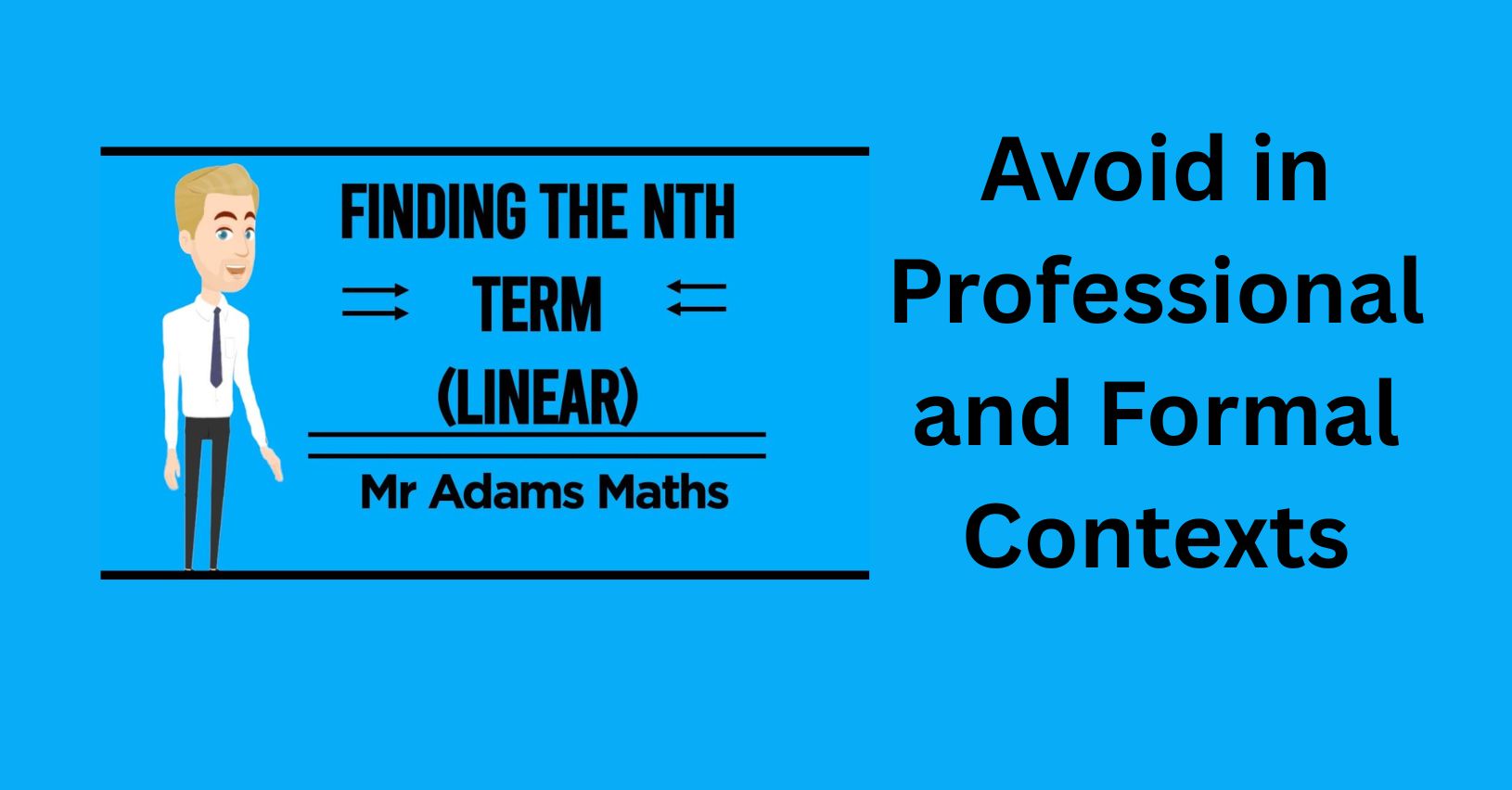
Nth Meaning Business writing requires specificity that “nth” explicitly lacks. Emailing clients, “I’ve requested these documents for the nth time,” sounds unprofessional and passive-aggressive simultaneously. Professional communication demands alternatives like “I’ve requested these documents three times this week.”
Academic writing (except for mathematical context) similarly rejects this informal expression. Scholarly papers need precise language; professors expect “The experiment was repeated multiple times” rather than vague mathematical notation references.
Why “Nth” Might Not Always Be the Best Choice
Nth Meaning Specificity in writing matters tremendously for effective communication. When you text “I’ve called for the nth time,” recipients wonder whether you mean twice or twenty times-this ambiguity undermines your message’s urgency.
The phrase carries an inherent negative tone that damages relationships unintentionally. Saying “explained for the nth time” sounds condescending, implying the listener is stupid for not understanding initially.
Perception Problems in Communication
Nth Meaning Lazy writing accusations follow “nth” usage in professional settings. Colleagues perceive it as intellectual shortcutting rather than efficient communication. Saying “This issue arose for the nth time” at meetings suggests poor documentation practices instead of emphasizing problem severity.
International readers and non-native English speakers struggle with this figurative language considerably. The mathematical origin doesn’t translate universally-many languages lack equivalent colloquial shortcuts. Global communication demands an accessible vocabulary that crosses cultural boundaries effortlessly, making “nth” a poor choice for diverse audiences requiring clarity in communication.
Building Better Alternatives
Nth Meaning Smart communicators develop a vocabulary range beyond single phrases. Writing tips emphasize maintaining varied expressions for similar concepts. Instead of defaulting to “nth” repeatedly, alternate between “repeatedly,” “countless times,” and “time and again.”
Matching tone to the audience requires conscious effort and practice. Your teenager appreciates informal expressions like “umpteenth time,” while your manager prefers professional equivalents such as “on numerous occasions.”
Powerful Alternatives to Replace “Nth” in Text
Nth Meaning Expanding your vocabulary with polite alternatives transforms vague frustration into clear communication. These synonyms maintain your intended meaning while improving message reception across diverse audiences and contexts.
Professional equivalents serve business writing needs perfectly. Terms like “repeatedly” and “on numerous occasions” convey frequency without sarcasm or ambiguity. Meanwhile, casual interactions benefit from colorful phrases like “umpteenth time” or “too many times to count” that add personality.
Casual and Conversational Options
“For the umpteenth time” carries playful dramatic emphasis perfect for close friends. This informal expression communicates frustration humorously without genuine anger, making it ideal for casual texting environments where relationships withstand gentle ribbing.
“Over and over again” provides emotional clarity lacking in “nth”. The repetition in phrase structure mirrors the repetition in action, creating linguistic emphasis that strengthens your message.
- “Countless times” emphasizes the impossibility of tracking occurrences
- “Too many times to count” adds conversational naturalness
- “Time after time” creates rhythmic, memorable phrasing
- “Again and again” delivers straightforward clarity
Professional and Business-Appropriate Phrases
“Repeatedly” stands as the gold standard for business writing and professional communication. This single word conveys frequency precisely without emotional baggage, making it perfect for performance reviews, client correspondence, or documentation purposes.
| Phrase | Formality Level | Best Context |
| Repeatedly | High | Business emails, reports |
| Frequently | High | Client communication |
| On multiple occasions | Very High | Legal, HR documentation |
| Time and again | Medium | Semi-formal correspondence |
| Incessantly | High | Formal complaints |
| Habitually | High | Behavioral descriptions |
Creative and Expressive Alternatives
- “Endlessly” injects dramatic emphasis into creative writing and personal narratives. This word amplifies emotional impact, making readers feel your exasperation viscerally. Content creators use it in blog posts to build connections through shared frustration experiences.
- “At every turn” provides narrative-friendly phrasing that enhances storytelling. This descriptive phrase works beautifully in articles, essays, or social media posts where engaging language matters more than clinical precision. It creates visual imagery that “nth” simply cannot match.
How to Choose the Best Alternative
- Choosing the right phrase depends on multiple factors, including relationship dynamics, platform norms, and communication objectives. Developing sensitivity to these variables dramatically improves message effectiveness and audience reception across contexts.
- Tone considerations should guide every word choice. Texting your sibling welcomes informal slang and playful sarcasm, while emailing professors demands professional equivalents showing respect.
Context and Relationship Analysis
Nth Meaning Casual texting with friends permits maximum informality and creativity. You can experiment with hyperbolic phrases like “millionth time” or invent new expressions because strong relationships tolerate linguistic playfulness. Digital conversations among peers thrive on this creative freedom.
Business writing demands conservative choices, prioritizing clarity. Professional communication succeeds through precision-saying “three times this week” beats vague alternatives every time.
- Close friends: Maximum informality accepted
- Colleagues: Balance professionalism with approachability
- Clients: Highest formality maintains credibility
- Family: Context-dependent flexibility required
Examples in Full Sentences Before and After
Seeing alternatives in action clarifies their practical application and emotional impact. These transformations demonstrate how word choice shifts perception dramatically while maintaining core message integrity across different communication contexts.
Personal communication examples reveal how subtle changes improve clarity without sacrificing warmth. Replacing “nth” with specific alternatives creates a stronger emotional connection while eliminating confusion about the severity or frequency of issues.
Household and Personal Scenarios
- Original: “For the nth time, turn off the lights.”
Improved: “I’ve asked you countless times to turn off the lights.” - The revision maintains frustration while improving specificity. “Countless times” creates a clearer mental image than mathematical abstraction, helping recipients understand issue severity better. This informal writing works perfectly for casual interactions at home.
- Original: “He repeated that story for the nth time.”
Improved: “He repeated that story again and again.” - This transformation adds rhythmic quality, enhancing memorability. The repetition within phrase structure emphasizes action repetition, creating linguistic coherence. It sounds more natural in digital conversations and spoken communication than mathematical references.
Professional and Business Contexts
Original: “This has happened for the nth time this month.”
Improved: “This has happened on multiple occasions this month.”
Professional communication benefits tremendously from this upgrade. “On multiple occasions” documents patterns without emotional loading, making it perfect for HR reports, client updates, or meeting minutes requiring objectivity.
Original: “I’ve reminded her for the nth time.”
Improved: “I’ve reminded her repeatedly.”
Single-word solutions often outperform complex phrases in business writing. “Repeatedly” delivers maximum clarity with minimum words, respecting readers’ time while maintaining professional standards. This efficiency matters enormously in corporate environments that value conciseness.
Tone and Cultural Considerations
Cultural clarity becomes critical when communicating across borders and backgrounds. What reads as playful sarcasm in American English might translate as genuine hostility elsewhere. International readers deserve consideration, ensuring your message lands as intended.
Non-native English speakers struggle particularly with mathematical notation turned slang. The conceptual leap from algebra to everyday frustration doesn’t exist universally. Global communication succeeds through choosing accessible vocabulary that crosses linguistic boundaries effortlessly.
Regional and Generational Differences
American communication norms vary dramatically by region. East Coast directness accepts informal slang differently than Southern politeness cultures. What works perfectly in California, casual texting might offend Texas business contacts expecting formal respect.
Generational gaps create additional complexity. Gen Z embraces internet slang and abbreviations eagerly, while Baby Boomers prefer traditional professional communication standards. Understanding these differences prevents miscommunication across age demographics within the same organization.
Best Practices for Replacing “Nth” Successfully

Communication clarity should always trump cleverness or brevity. When choosing between “nth” and clearer alternatives, select precision every single time. Your audience deserves understanding your message without mental gymnastics, decoding mathematical references.
Matching tone to the audience requires emotional intelligence and situational awareness. Practice reading messages from recipient perspectives before sending. Does your word choice align with relationship dynamics and communication context? This simple check prevents countless misunderstandings.
More post: WBY Meaning Never Confuse This Text Abbreviation Again in 2025
Practical Implementation Strategies
Writing tips emphasize conscious vocabulary development through consistent practice. Each time you start typing “nth”, pause and consider better alternatives. This deliberate approach builds a mental database of professional equivalents and polite alternatives for future use.
Best practices in writing include soliciting feedback from trusted colleagues or friends. Ask whether your messages convey the intended tone clearly. Outside perspectives reveal blind spots in your communication style that self-editing misses consistently.
Frequently Asked Questions
What does nth mean in text?
“Nth” means an unspecified number of times, typically expressing repetition or frustration. It originates from mathematical notation where ‘n’ represents any variable number in sequences.
How is nth commonly used in text?
People typically use “nth” in phrases like “for the nth time” to express exasperation about repeating themselves.
What is the meaning of nth?
“Nth” refers to something at an unspecified or high position within a series. Mathematically, it denotes any term in a sequence. Colloquially, it means “many” or “countless” times.
How do you use nth in a sentence?
Use “nth” in informal contexts: “I’ve explained this for the nth time,” or “She’s watched that movie for the nth time today.”
Conclusion
Understanding the nth meaning in text empowers you to navigate modern digital communication confidently. While this mathematical notation turned informal slang works perfectly in casual texting, it fails dramatically in professional communication, requiring precision and clarity. Smart communicators develop extensive vocabularies of alternatives matching every context and relationship.
Whether choosing “repeatedly” for business emails or “umpteenth time” for friend texts, your word selection shapes message reception dramatically. Prioritize communication clarity over shortcuts, match your tone to audiences, and practice contextual flexibility.

Passionate about innovation and growth. Dedicated to managing, optimizing, and creating seamless experiences while supporting diverse content and users with professionalism and clarity every day.